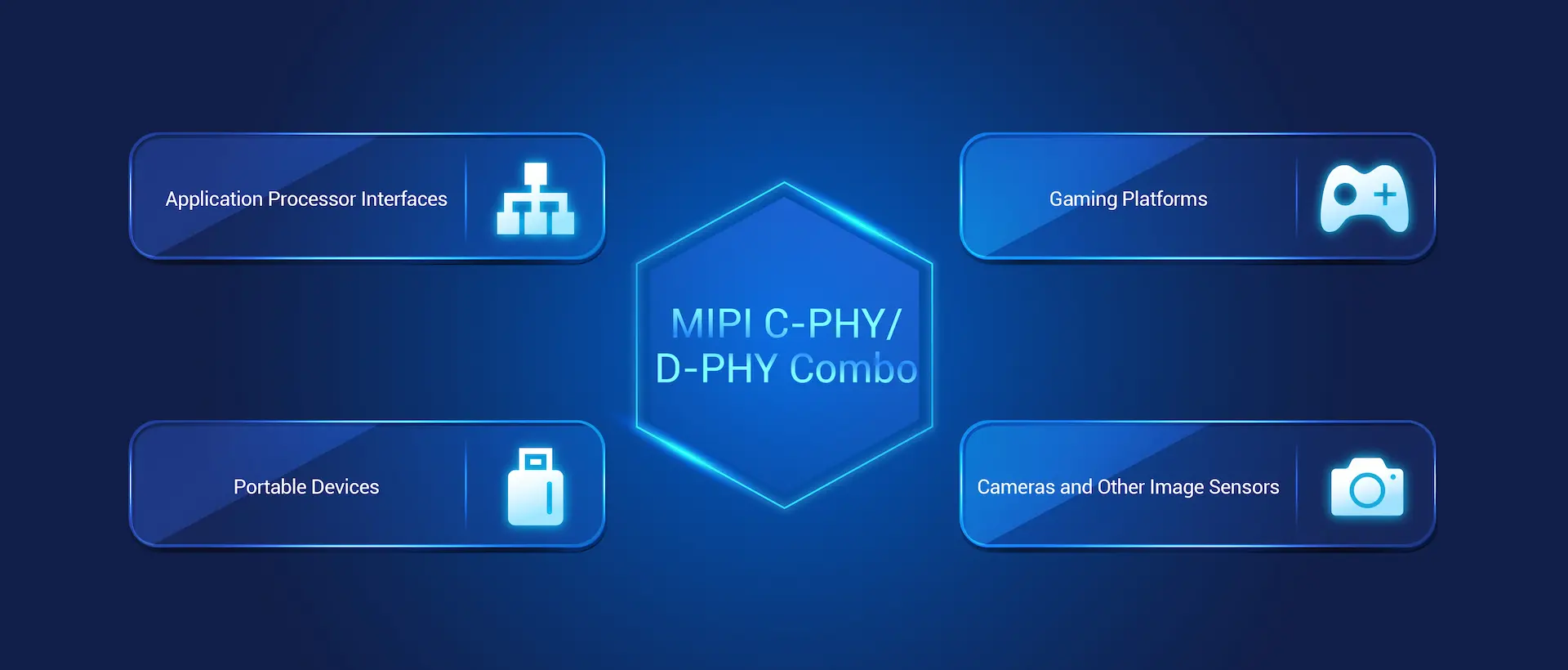
The D-PHY and C-PHY support the electrical portions of the MIPI D-PHY V2.0 and MIPI C-PHY V1.1 standards, covering all transmission modes (ULP/LP/HS). This IP cost-effectively adds MIPI D-PHY and MIPI C-PHY functionality to any SoC used in communications and consumer electronics.


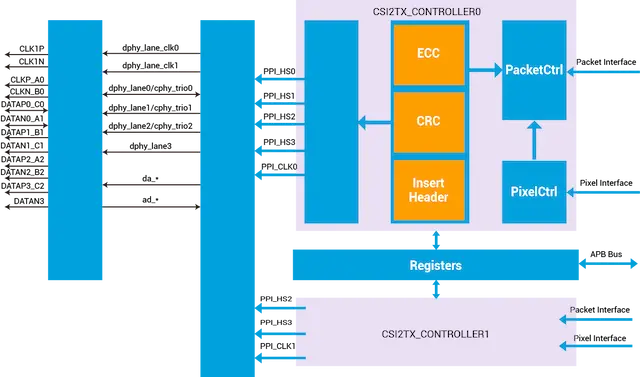
Innosilicon's CSI-2 controller implements the MIPI CSI-2 V1.3 protocol. The CSI-2 link protocol specification is part of a set of communication protocols defined by the MIPI Alliance standards for chip-to-chip communication in mobile systems. The CSI-2 specification specifically targets communication between cameras and image application processors.
Innosilicon's DSI-2 controller implements the MIPI DSI-2 V1.0 protocol. The DSI-2 link protocol specification is part of a set of communication protocols defined by the MIPI® Alliance for chip-to-chip communication in mobile systems. The MIPI DSI specification targets display communication in image application processors.
Innosilicon I/O and ESD are also built into a rectangular package suitable for any configuration. It is optimized for high-speed applications, with robust timing and a small silicon footprint.


Low power
Fully customizable
High-speed hub with VLPI low latency
Small area
Simple integration process
Available options include
Test chip and test board
FPGA integration support
Chip-level integration
Compliant with the MIPI® Alliance D-PHY V2.0 specification
Compliant with the MIPI® Alliance C-PHY V1.1 specification
Compliant with the MIPI® Alliance DSI-2 V1.0 specification
Compliant with the MIPI® Alliance CSI-2 V1.3 specification
Supports HS, LP and ULPS modes
Maximum data rate of 4.5Gbps per lane in D-PHY mode
Maximum data rate of 3.5Gsps per trio in C-PHY mode
Asynchronous transfer in low-power mode at 10Mbps for C-PHY and D-PHY
Supports unidirectional and bidirectional modes
Supports D-PHY skew calibration
Supports ECC and CRC insertion
Automatic termination control for HS and LP modes
Buffers with adjustable on-chip termination and advanced equalization
Supports BIST logic
Supports combined LVDS/TTL IP
Can be delivered together with DSC1.2A
Datasheet and physical implementation guide; netlist (Spice format for LVS)
Library Exchange Format (LEF)
Verilog model
GDSII for foundry IP merge
Module integration guide
Silicon validation report (when available)
Evaluation board (when available)