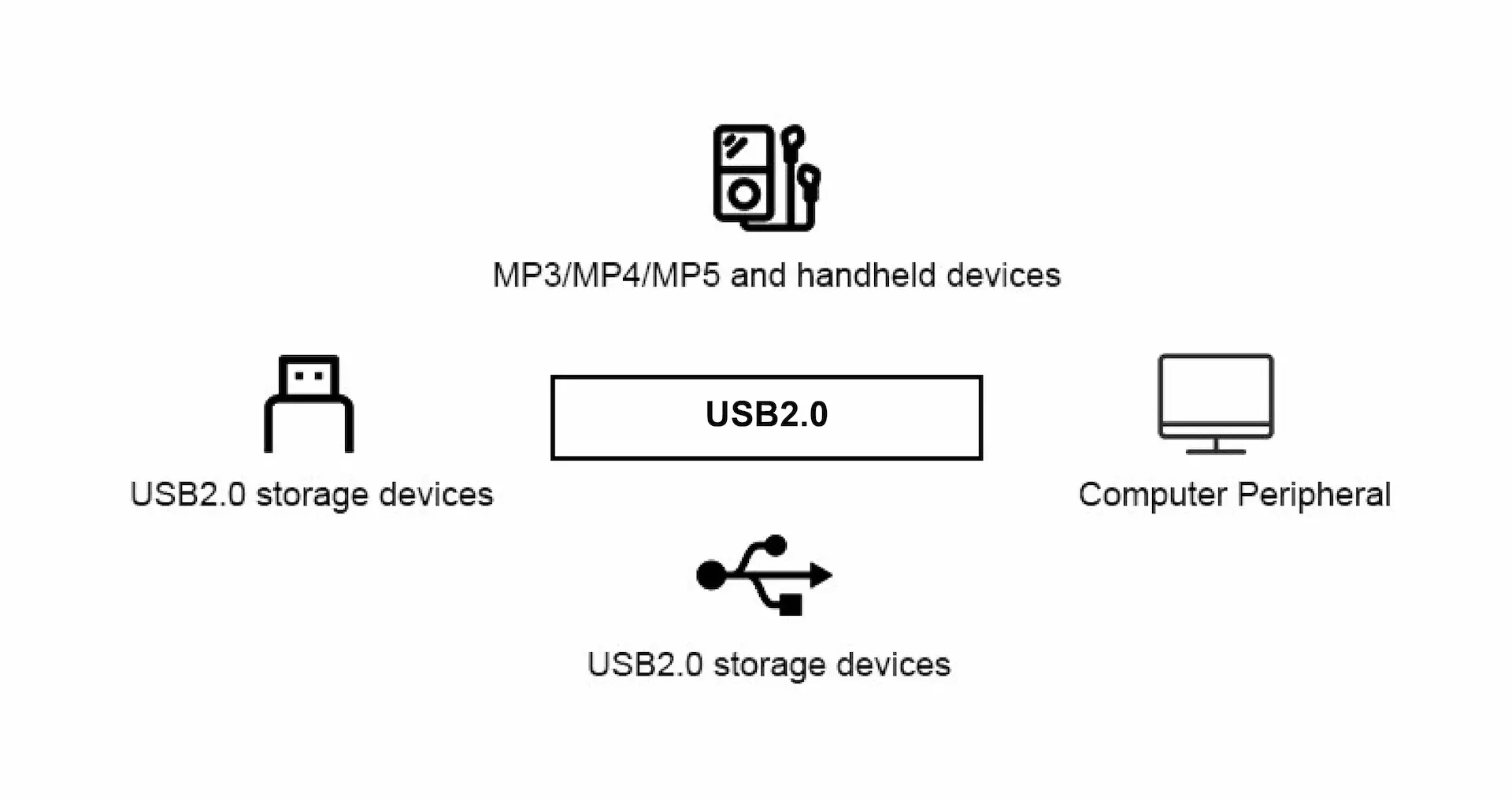
USB is the preferred peripheral interconnect standard for a vast range of computing and consumer applications. Innosilicon provides comprehensive software drivers supporting common USB peripherals. In addition, our existing USB ecosystem — including USB silicon vendors, design IP companies, and verification and test vendors — effectively lowers costs for manufacturers of USB host and peripheral products.


Innosilicon's USB 2.0 PHY complies with the UTMI+ Level 3 Revision 1.0 (USB 2.0 Transceiver Macrocell Interface Plus) specification and delivers excellent performance. As an integrated high-speed mixed-signal circuit, it supports 1.5Mbps low speed (LS), 12Mbps full speed (FS) and 480Mbps high speed (HS), while maintaining backward compatibility with legacy USB 1.1.
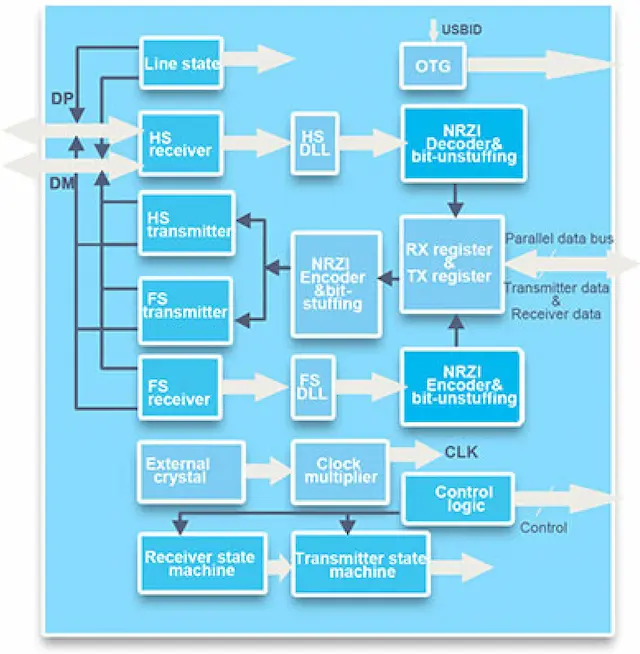
Innosilicon's USB 2.0 PHY handles low-level protocol and signaling. In TX mode, the PHY serializes data, performs NRZI encoding and bit stuffing as needed, and generates the SYNC and EOP fields. Likewise, in RX mode it recovers the clock from incoming data, strips the SYNC and EOP fields, performs NRZI decoding and bit unstuffing as needed, and deserializes the data. It supports 17 operating modes, including LS, FS, HS, On-The-Go (OTG), device and host.
Innosilicon's USB 2.0 PHY can be preconfigured with a 30MHz 16-bit or 60MHz 8-bit UTMI data interface, providing a complete on-chip transceiver physical solution with ESD protection.
The eUSB2 IP supports native mode and repeater mode for more flexible applications. The eUSB2 repeater converts between standard USB 2.0 and eUSB2 signal levels, allowing legacy USB 2.0 devices to connect to a system-on-chip (SoC) with an eUSB2 PHY. Building on years of customer success, Innosilicon offers a silicon-proven, customizable eUSB2 PHY fully compliant with the USB Implementers Forum (USB-IF) eUSB2 and USB 2.0 specifications.


Low power
Fully customizable
High-speed hub, VLPI low latency
Small area
Easy integration
Optional services include
Test chip and test board
FPGA integration support
Chip-level integration
Compliant with USB Specification Revision 2.0, 1.1
8- or 16-bit UTMI interface, compliant with UTMI+ Specification Level 3 Revision 1.0
Compliant with the OTG Supplement to the USB Specification Revision 2.0 (optional)
480Mbps (HS), 12Mbps (FS) and 1.5Mbps (LS) serial data transfer
Low-latency hub mode with 40-bit latency
Supports all test modes defined in USB Specification Revision 2.0
Supports scan and loopback BIST modes
Built-in I/O and ESD structures
On-chip self-calibrated HS/FS/LS termination
Supports 12/19.2/20/24MHz external crystal or on-chip reference clock with PLL oscillator
Embedded ESD circuits: 2000V HBM, 500V CDM
Datasheet and physical implementation guide
Library Exchange Format (LEF) files
Gate-level netlist and Standard Delay Format (SDF) timing files
Encrypted Verilog model
Flattened layout vs. schematic (LVS) netlist and reports
Design Rule Check (DRC) report
GDSII database for foundry merge
Test chip and FPGA support (optional)
Back-end integration (optional)