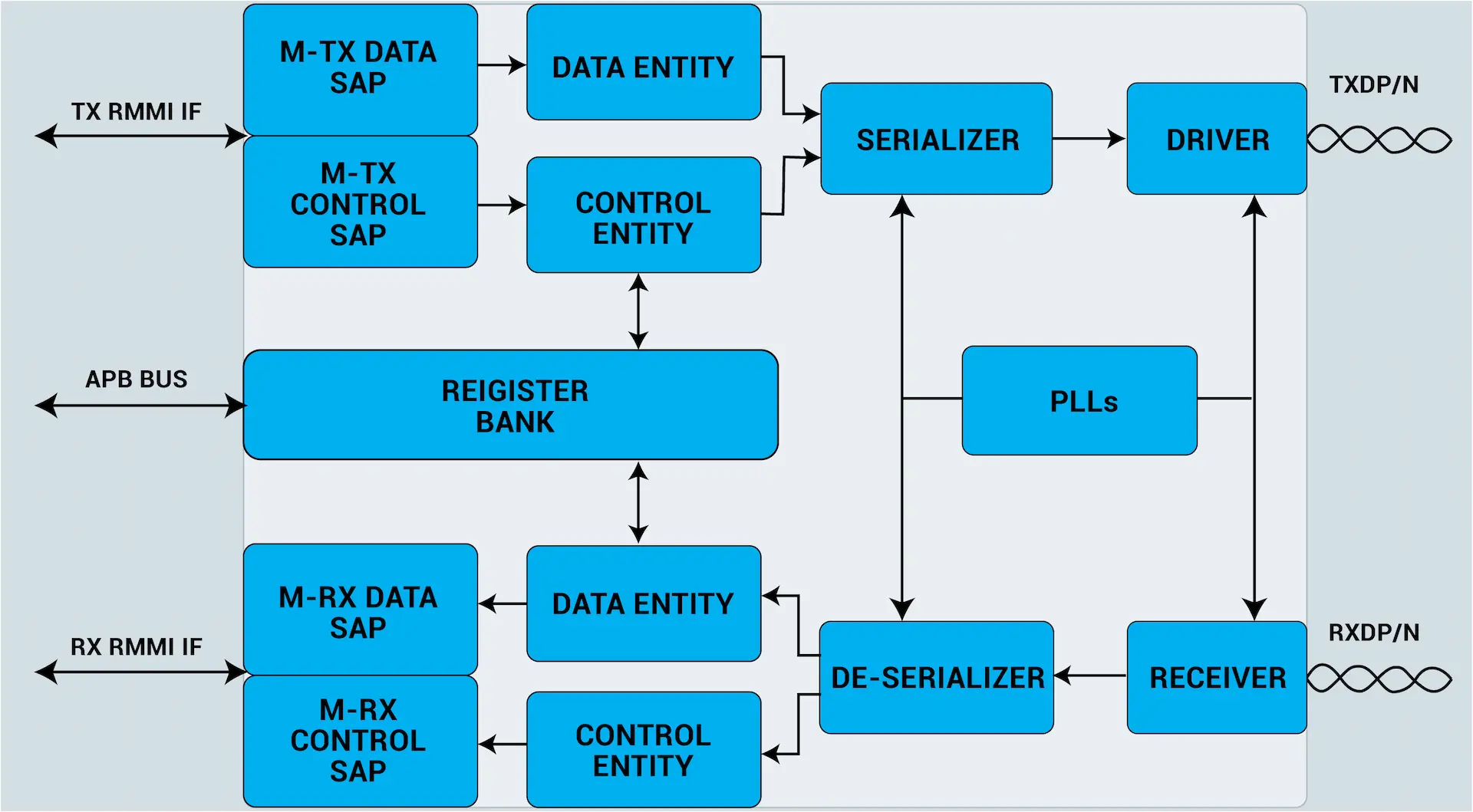
Innosilicon's M-PHY implements the MIPI M-PHY protocol V3.0. The M-PHY protocol specification is part of a set of communication protocols defined by the MIPI® Alliance standards for chip-to-chip communication in mobile systems. The M-PHY specification is purpose-designed for multiple protocols and has a wide range of applications.


Innosilicon's M-PHY includes a transmitter and receiver for full-duplex operation. The IP supports multiple burst modes, including HS and LS, to improve power efficiency, as well as several power-saving modes that trade off power consumption against recovery time.
Innosilicon I/O and ESD are also built in, providing a convenient drop-in PHY. The design is optimized for high-speed applications, with robust timing and a small silicon area.
Innosilicon's M-PHY supports the electrical portion of the MIPI M-PHY V3.0 standard and cost-effectively adds MIPI M-PHY V3.0 functionality to any SoC.


Low power
Fully customizable
High-speed hub with VLPI low latency
Small area
Simple integration process
Available options include
Test chip and test board
FPGA integration support
Chip-level integration
Compliant with the MIPI Alliance MIPI M-PHY V3.0 specification
Standard RMMI interface supporting UniPro™ (UFS2.1, CSI-2, DSI-3), SSIC and LLI
Supports 2 lanes in the M-TX and 2 lanes in the M-RX sub-links
Supports HS mode (GEAR1~3, A/B)
Supports LS mode (PWM G0~G3)
Data rates up to 5.8304Gbps per lane
Supports M-PHY Type-I and Type-II
Reference clock frequencies: 19.2/26/38.4/52MHz
Supports LS-BURST, HS-BURST, STALL, SLEEP and HIBERN8 states
Dynamic configuration and control through core ports
Datasheet and physical implementation guide; netlist (Spice format for LVS)
Library Exchange Format (LEF)
Verilog model
GDSII for foundry IP merge
Module integration guide
Silicon validation report (when available)
Evaluation board (when available)